
Store of Value

What is a Store of Value (SoV)?
A store of value is any commodity or asset that would retain or increase future purchasing power and can be saved, retrieved, and exchanged at a later time.
An ideal store of value would be scarce, demanded, durable, and useful.
Let’s take Gold for example:
-
Gold is a scarce commodity; there’s only a limited supply, and it’s very expensive to mine.
-
Gold has been in demand by humans since forever, largely for its SoV properties.
-
Gold cannot rot, rust, oxidise, or tarnish.
-
Gold has been used as money for thousands of years to this day. Only 6-8% is from technological demand.
All of these amazing properties are what made gold the oldest and most used asset as a store of value.

The case for Bitcoin as a store of value.
Scarcity
Bitcoin is a scarce asset; its scheduled inflation rate halves every four years until the year 2140, when the entire supply of Bitcoin will have been mined (~21 million Bitcoins). It’s also very hard and expensive to mine, and unlike gold, if the price rises and more people decide to mine Bitcoin, the issued supply remains the same (thanks to mining difficulty adjustment seen in the Bitcoin Mining chapter).
As of today, 95% of the entire supply has been mined. Which means that the remaining 5% of the finite supply of Bitcoin will take over a century to be mined.
Imagine what would happen to the price of gold if the amount mined per year were reduced by half every four years?


Did you know?
Bitcoin's inflation rate is already lower than gold's Today Bitcoin's annual supply inflation is roughly 0.8%, while estimates for gold's annual supply growth are around 1.5–2.0%. Bitcoin is already harder than gold from a new-supply perspective.
Demand
Bitcoin demand hasn’t ceased to grow since its creation. It went from an internet money used by a few cypherpunks to millions of users worldwide today. Helping people all over the world to opt out of an infinitely printed government money, their control, and abuse of it.
A very interesting comparison is with the adoption rate of the internet.
From 1983* to 1999 the internet went from a few thousands to almost 200 millions of users, just like Bitcoin did from 2009 to 2024.
Today, it’s estimated that around 250 millions of people are using Bitcoin worldwide.
*Why 1983? The formal establishment of the internet as a unified system occurred on January 1, 1983. This date is often considered the official birthday of the internet.

Recently, we have seen some of the biggest hedge funds in the world caving to Bitcoin by allowing their consumers to get Bitcoin exposure using their ETF, the same hedge funds from which their famous CEOs laughed openly at Bitcoin, calling it a scam with no value.
The demand for Bitcoin ETFs is such that BlackRock’s iShares Bitcoin Trust (IBIT), launched in January 2024, has become the firm’s most profitable exchange-traded fund and its most profitable product line.

Durability
Bitcoin has demonstrated an exceptional uptime of 99.99% since its creation in 2009, surpassing centralised giants like Google and Amazon while being completely decentralised and secured by the largest proof-of-work network in the world. Its digital characteristic also makes it immune to rot, corrosion, or degradation.

In its lifetime, Bitcoin only went down twice. Once in 2010 for eight hours and 27 minutes due to a bug (CVE-2010-5139), and another time in 2013 for six hours and 20 minutes due to another bug (CVE-2013-3220). Ever since the bug in 2013, Bitcoin has not gone down again, proving its undeniable durability while being completely decentralised.
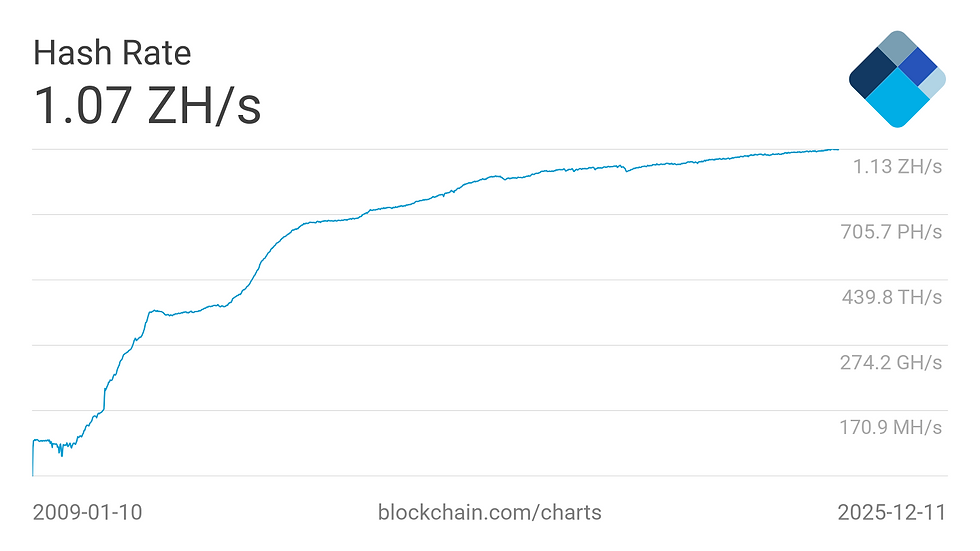
Bitcoin’s hash rate has risen steadily throughout its lifetime as its growing value attracts new regions, energy sources, and technologies to participate in mining.
The amount of computing power, as seen below, is what makes Bitcoin highly secure but also proves its incredible durability; an enormous amount of resources is used to protect the Bitcoin network all around the world, and it hasn’t stopped increasing as more people discover how Bitcoin mining might help them solve real-world problems.

To finish this point, consider one of many Bitcoin addresses that has not moved since 2010. The address shown above holds over 28,000 BTC, worth nearly $2.5 billion. These coins may be lost, the owner may have passed away, or they may simply be holding them intentionally.
The key point is that many such addresses exist, and as long as the private key is owned and properly secured, Bitcoin can remain untouched for decades and can still be used at any time—without degradation, expiration, or loss of value through custody.
Utility
Bitcoin’s main utility, in short, is being a form of money that anyone can store or transfer without intermediaries, but let's dive a bit deeper.

Bitcoin is used for many case, here's a few:
-
Borderless payment system: Fast final settlement without intermediaries, low fees.
-
Self-custody and financial sovereignty: You can hold Bitcoin without any intermediary, no reliance on banks, governments, or custodians, and the funds cannot be seized without the private keys.
-
Censorship-resistant: Bitcoin is widely used in regions with capital controls or unstable regimes since payments cannot be frozen or reversed.
-
Inflation-resistant: Bitcoin provides monetary stability where fiat fails, having a very stable, ever-decreasing issuance schedule.
-
Emergency Wealth Portability: You can move large sums of money with only 12 words, either written or memorised. Useful in crises, migration, or conflict situations.
-
Long-Term Inheritance: Bitcoin can be passed across generations without intermediaries or making any transfer by simply passing on the seed phrase that gives full control over the Bitcoins.
-
Energy Monetisation: Bitcoin mining can monetise excess or stranded electricity by converting it into a liquid, global asset, improving energy project economics, and reducing waste from sources such as solar, wind, or flared gas.
-
Store of value: Bitcoin is widely used as a store of value due to its very scarce design, demand, durability, and utility.
This is only a list of the main use cases for Bitcoin today. As more people learn about Bitcoin in the future, many more use cases may come to light.